

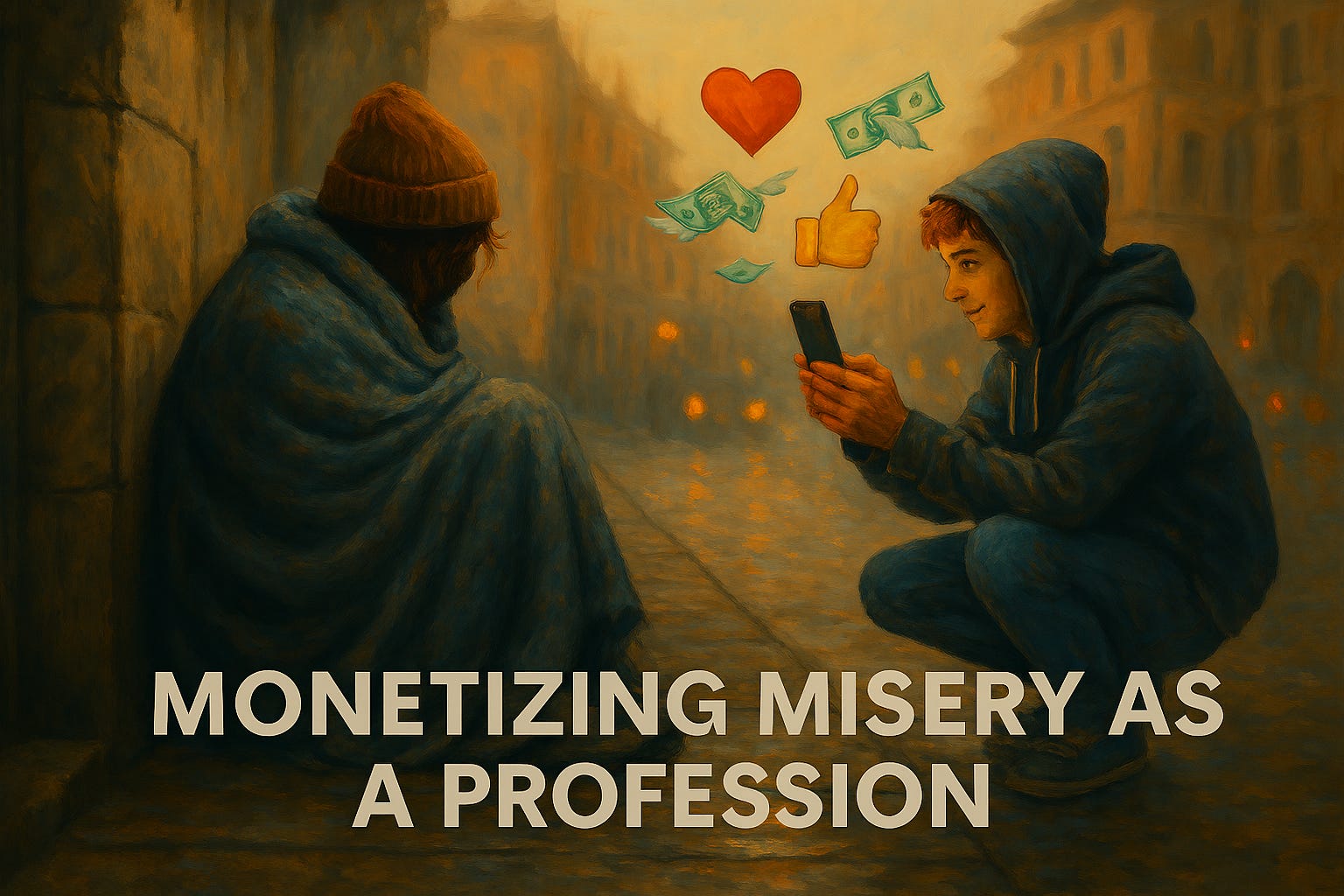
Monetizing Misery as a profession.
The business of spotlighting struggle.

In a world that increasingly values purpose over profession, some lines of work still grow quietly by feeding on the hardship of others. One clear example today is a certain kind of travel vlogging. These creators often travel from well-to-do countries to less developed regions, phone or camera in hand, actively seeking scenes that show the host nation at its lowest. They edit these moments into dramatic stories, upload them to social platforms, and within hours the content goes viral. Views rise, revenue follows, and the cycle of monetizing misery continues.
So how does content that claims to be purpose driven turn into profit driven storytelling?
For the vlogger, the profession is simple. Create videos, attract views, build followers, and earn money. The stated purpose often sounds more noble. Many claim they are “showing the truth” so that countries can improve. But this raises an obvious question. If the goal is genuinely to help, why is the message aimed at a global audience rather than the people who can actually drive change?
Highlighting a country’s problems is not the same as helping solve them. When images of poverty, pollution, or unsafe living conditions are shared worldwide, local communities rarely see reform. Instead, they see stereotypes reinforced. A single video can shape perceptions for millions of viewers who may never visit the place. A slum, a landfill, or a chaotic street scene might attract clicks, but it also creates a narrow narrative that ignores culture, resilience, and progress that exist alongside these realities.
The truth is more nuanced. Not everything is perfect anywhere, but choosing only the worst angles is a deliberate editorial decision. It simplifies complex societies into digestible drama and drama always sells.
The larger question we must ask is this: When awareness becomes entertainment, and empathy becomes content, whose purpose is truly being served?
Until creators widen their lens to show both the challenges and the strengths of the places they visit, this profession will continue to drift toward what it has quietly become a business built on the easy currency of other people’s struggles. It may also be worth reflecting on the value systems of the vlogger that make it acceptable to turn someone else’s misery into economic gain under the disguise of “Freedom of Expression”.
That's a really thought-provoking post. I definitely agree with you that the monetization of other people's misery is becoming a "standard" in the industry of supposedly entertainment. If I were to expand this even further, I'd say that this is becoming a "standard", not only in the way you describe it, but rather in human relationships as well like you mentioned, where no one cares about the other, even in the way that people say they do.
"Highlighting a country’s problems is not the same as helping solve them.", that's true but they are both equally important. Highlighting awareness is some kind of proof of existence, and you need it if you were to raise "helping hands", but I strongly agree with you that the way it takes shape in the current world is not what the concepts of sympathy and helping others stand for from my point of view.
Extremely nuanced viewpoints
Good stuff lotus eater